



Frequently Asked Questions
How is the EEFC organized? The EEFC is a not-for-profit 501(c)(3) organization governed by a 7-member volunteer board. The board is responsible for defining and promoting the mission of the organization, and oversees operations, staff, and various committees. Board members chair programming, finance, fundraising, and development committees.
Current board members, and their offices and/or chaired committees, are listed on the Board of Directors page. You can reach the board at board@eefc.org
The EEFC staff are listed here.
Members: How does one become a member of the EEFC? Membership is an annual giving program to help cover the gap between workshop tuitions and the cost of putting on our programs. There are no benefits to membership other than the warm glow of knowing that you are contributing to the continued existence, health, and growth of our organization.
Click here to learn more about membership and to join.
I can’t attend a camp, but I’d like to learn more about Balkan music and dance. How can I do this? The EEFC email discussion group is a great resource for finding events in North America and abroad. If you join the forum, you will find that the community is generally happy to offer information and resources about music and dance. There is a wealth of knowledge out there. The discussion forum archives are also available for keyword searching. Click here to learn more and to sign up.
This website is also (as it develops) a resource for information about Balkan music and dance. Check the Balkan Culture section to learn about instruments, cultures, and dance and musical styles.
Our Facebook page also has information about music and dance events around the US. “Like” the page to get updates.
eBay: What is the EEFC eBay store? Our eBay store offers a unique way to donate and purchase goods and to support the EEFC. The store is managed by longtime eBay seller and EEFC member Yvonne Wingard. Click here for more information.
Workshop Program
How do you select the teaching staff for workshops? Our volunteer Program Committee works year-round to plan classes and select the teaching staff for both workshops. Their goal is to provide a diverse range of instruments, singing styles, dance styles, and levels each year, taught by musicians/dancers who have well-honed teaching skills. Since we can't offer each and every class we'd like to at every workshop, the Committee also tries to balance the slates from year to year.Many of our teaching staff are also involved in playing for our evening parties, so their skills and familiarity with a diverse range of musical styles is also key in our selection. Back to top
What classes are offered? Roughly 45 dance, singing, and instrument, and ensemble classes, are offered each day. Please review the camp brochure for the specific offerings of each camp. You will be given a schedule at camp registration with the specific times of the classes.
You will note that there are 5 class periods per day, and you can take as many classes as will fit into your schedule. You may want to allow time for a nap or a swim too. Back to top
Class schedules: There is sooo much to choose from, or, How come I can’t take every class that I want? As you will see when you study your workshop schedule (which you will receive when you arrive at camp), there are roughly 45 classes held each day, during 5 class periods. We try to use smart scheduling to foresee potential conflicts, but given how many classes we offer, it is not possible to alleviate all of them! Bottom line — campers sometimes have to make choices, hard as that may be. Back to top
How do I know which level of class to take? Classes are offered at beginning, intermediate, and advanced levels, though not all are offered each year. Our instructors do their best to teach to the advertised level of the class. If you are not sure which level is best for you, please consult with the teacher.
If you wish to take a class in a higher level than you feel comfortable with, you can audit the class. Please be aware that the instructor may not be able to take extra time to help you catch up. Similarly, you are welcome to join a beginner class even if your skills are more advanced—just be aware that the class will be paced with beginner-level students in mind.
If you are considering taking an advanced class, please include your skill-level with Balkan styles as part of your decision-making process. Though you may have proficient instrumental/vocal skills, you may find that you need a lower level in order to learn the fundamentals of style. Back to top
How are workshop classes taught? We give our teaching staff the freedom to choose their teaching methods and material. As such, you will find a variety of teaching styles at our workshops. Some teachers will provide sheet music, and others will focus on subtleties and nuances that can only be learned by ear. Some dance teachers provide syllabi with dance step notation, but most do not.
Many attendees choose to bring recording equipment to help them as they learn. Back to top
Ensembles Classes: How do they work? Each camp offers several (5 or 6 in 2011) ensemble classes as part of it’s program. These groups are led by experienced musicians, and offer an opportunity for campers to play together with others and learn from a specific repertoire. Each ensemble will play for dancing on the final night of camp. Back to top
Instruments: Can I borrow an instrument that I want to study? We operate an instrument loan program for traditional instruments (tambura, tamburica, oud, kaval, gajda, tupan, dumbek, frame drum, and zurla). Please indicate your need to borrow on your registration form. It's also worth asking in your local community, as we can't guarantee finding you a loaner instrument.
For common Western instruments, e.g. violin, clarinet, accordion, please plan to bring one with you from home. If you don’t own one, perhaps you can borrow or rent one for the week. Back to top
Evening Parties: How do they work? Parties are scheduled in the dance hall each night from 9 p.m. until midnight or later. Performers are designated in advance, by the Program Committee. There are usually two sets per night. Also, a snack is served during the later part of the evening. Back to top
Dancing: I don’t know these dances. How can I participate? Our parties are a great place to learn. Start with dances that look simple, but be aware that sometimes a dance may become faster and more complex by the end. There’s no shame in bowing out of the line if you need to. Asking someone to guide you through a dance can also be useful. Some people find it easier to follow along behind the line for a bit, and some find it simpler just to jump in and let the rhythm of the line help guide their feet.
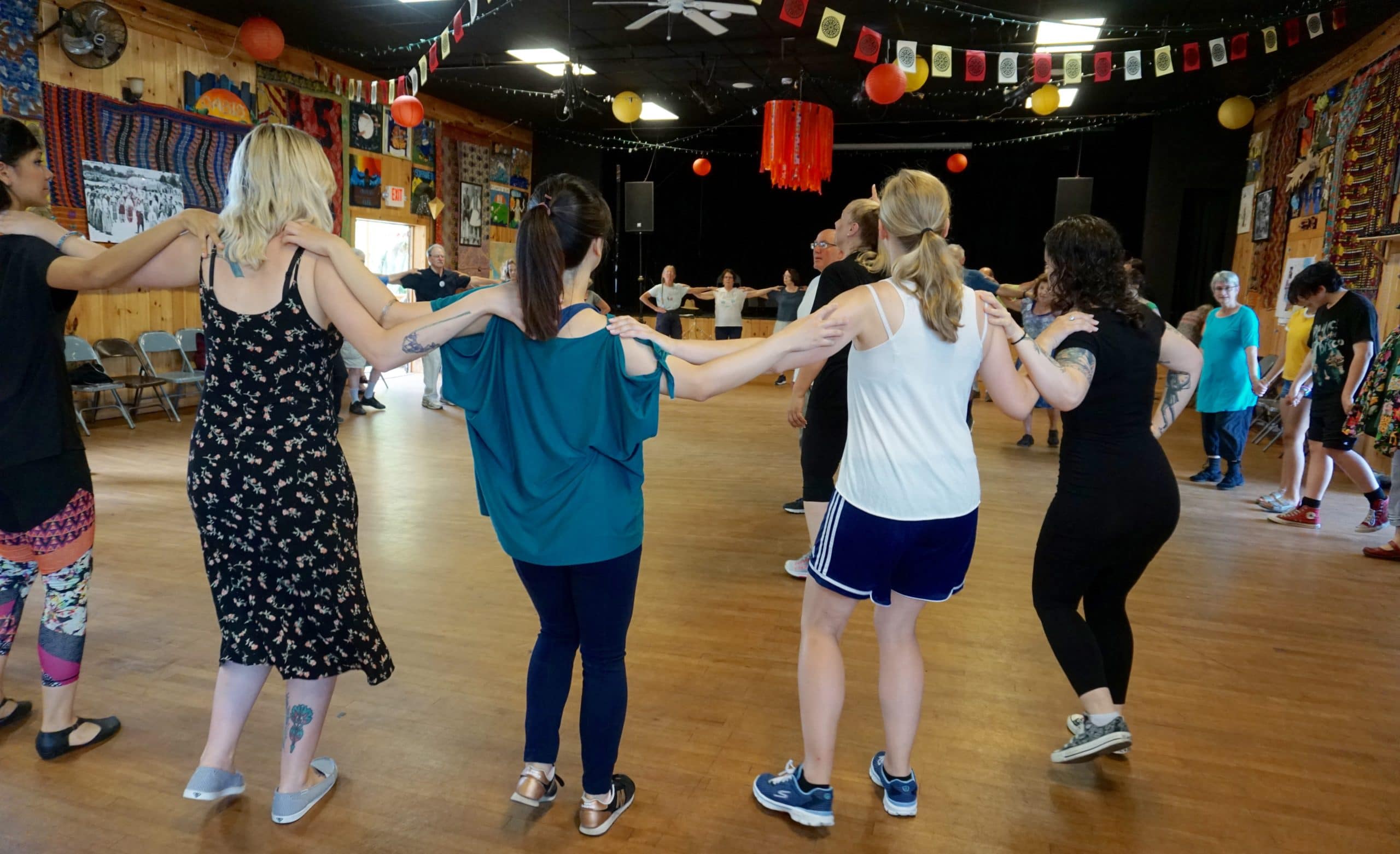
Most of our dances are done in long circling or spiraling lines that move to the right. The person on the far right of the line is the leader. Dancers look to the leader to establish the basic pattern and style of the dance. Sometimes the leader will embellish her/his steps more than other dancers. It is usually best to join the line at the far left end. Back to top
Kafana: What is it? The kafana is an informal café that runs late into the night. With a blend of camper and staff bands, there is lots of diversity in what you will hear. Much of the music is for dancing, though some is for listening. Beverages are for sale at the kafana. Mendocino serves evening snack adjacent to the kafana. At Iroquois Springs, a variety of delicious Balkan appetizers are for sale. Back to top
Playing: I want to perform! How can I get on the schedule? The music for evening parties in the dance hall features the camp staff, - those individuals who are hired to teach and perform at camp. They make their own decisions in choosing their ensembles, which can include other staff musicians as well as campers.
The kafana offers opportunities for ANYONE, campers and staff alike, to perform. Contact the kafana coordinator early in the week to get on the schedule. Back to top
Student Concert: How does it work? Each class will present a 2 minute demonstration of the music that they have learned during the week. The concert is held on the final afternoon of camp. This is a low-pressure event, so even beginners participate. Back to top
Ensemble Night: Who plays? Each of the official ensembles (those that are part of the official class schedule) will have a 20 minute dance set during the last evening party of camp. Back to top
Kids programs: What do kids do at camp? We actively encourage children of all ages to come to camp, and seek their participation in our program in a multitude of ways. Children are invited to participate in all regular activities along with adult campers, such as classes, evening parties, and kafana. They are also welcome to set up special kids-only events throughout the week. At Mendocino, one room is reserved for kids only from 9-12 every night.
In addition, several multi-age programs for children are offered at each camp. Please check the camp brochure for the specifics, as there is some variation from year to year. These programs generally feature a combination of musical activities, arts and crafts, and performance rehearsals. Children usually perform at the Student Concert on the last day of camp.
More on what to expect bringing or sending kids to camp.
Corinna Snyder is the parent liaison. If you have a question, email her at board@eefc.org
Back to top
Recording: Is it allowed? Taping and recording of evening party performances is allowed for personal use only and not for distribution including uploading to Youtube or other public venues. Please plan to record in a manner that does not interfere with the other participants. If you would like to record in your classes, please get permission from your instructor before you do so. It's best to check with folks you record if you hope to share your recordings publicly online.
Teachers may provide recordings of the materials that they will cover at camp. Some bring copies to give or sell (for a minimal fee) to their students. A CD copy machine is also generally available at a central location of camp for use by campers. Back to top
Languages: Do all teachers speak English? Some of our instructors are more comfortable teaching in their native language. In these cases, an interpreter is partnered with the teacher, so that all classes are essentially taught in English. Back to top
Camp Life
Who is in charge? Each workshop is coordinated by a Site Manager, who is responsible for handling the day-to-day details of camp life. In 2011 the Mendocino Site Manager was Helen Stuart and the Iroquois Springs Site Manager wasNancy Butowski. For more on the Site Managers click here. Back to top
What are the camp facilities like?
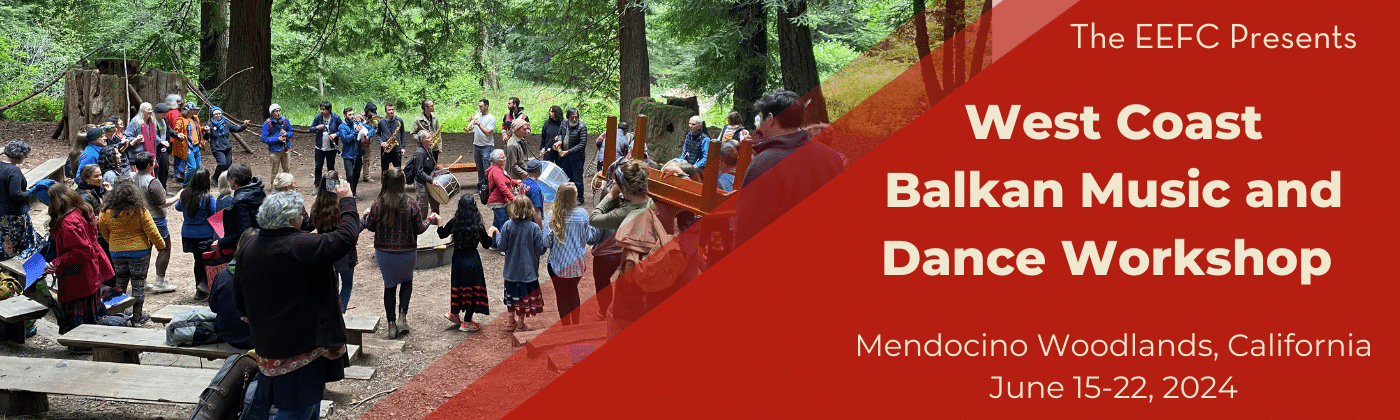
Our beloved Mendocino Woodlands camp is a National Historic Landmark located in the redwoods of Jackson State Forest. The camp is rustic and hilly, with uneven dirt trails and some stairs. Getting around the site can be difficult for people with joint problems. Accordion players have been spotted using luggage carts to haul their instruments up the hills.
Mendo can be cold, both at night and during the day, and the temperature varies widely, from as low as 40F at night, to the occasional high of 70F during the day. More detailed information about the Mendocino site, and what you'll need to bring for a week.
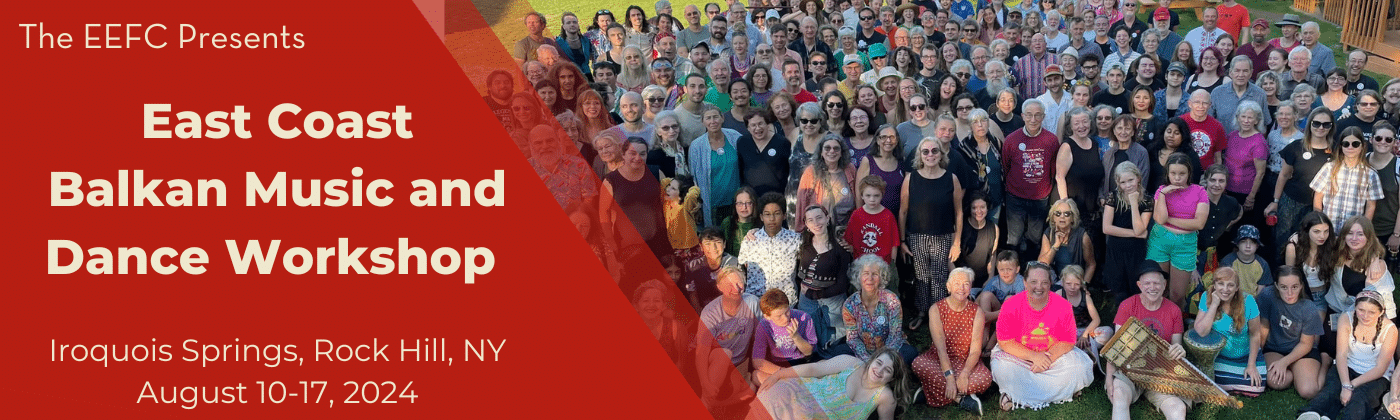
The Iroquois Springs camp is conveniently located in the Catskills region of eastern New York state. During most of the summer it is a camp for kids. Once their summer-camp season is over, the EEFC and other groups use the facility. The camp and its buildings are well maintained, and most of the buildings that we use are near one another. The ground is fairly level, so the site is generally manageable for people with physical limitations. The camp is divided into two distinct sections, and the EEFC uses only one of these. Sometimes another group uses the other section, and their campers can overlap with ours in the dining hall.
Iroquois Springs experiences the hot and sometimes steamy weather that is typical of the mid-Atlantic section of the country. Campers should also be prepared for rain. More detailed information about the Iroquois Springs site, and what you'll need to bring for a week. Back to top
I'm new to Balkan Camp. How will I meet people?
We were all new to this community at one time, and people can be very welcoming. Though it may at first seem as if everyone has known everyone else for years, that doesn't mean you can't become a part of it.
To help to make you feel welcome, we have a buddy system for new campers. Your buddy can answer your questions and help you find people with similar interests. Just be sure, on your registration form, to check the box that this is your first EEFC workshop. You’ll be told how to find your buddy once you arrive at camp.
The Student Orientation meeting, held on the first night of camp, is an invaluable resource for new and returning campers. Here you will learn the details of camp life, and each of the teaching staff will make a brief presentation to help you choose which of the many fabulous class offerings to take. Back to top
Food: What kind of food is served at camp?
We offer plentiful, healthy food at both camps. including vegetarian options as an alternative to meat-based dishes. Campers MUST sign up when they register for the vegetarian options and stick with that decision all week. We aim to please, but we cannot be responsible for other special diets, so you will need to provide for yourself.
If you have specific food allergies, please let the head chef know, so that they can advise you on which foods to avoid.
After rave reviews last year, the food at Mendocino will again be provided by Todd Lysether and his crew.
The kitchen at Iroquois Springs is run by Janet Diamond Bradley, who has been cooking for EEFC’s East Coast camps for decades. As a professional chef, Janet’s meals, snacks, and desserts have been fine-tuned to be real crowd-pleasers. Back to top
Cabins: What are the cabins like?
Cabins at Iroquois Springs are medium-sized buildings that comfortably accommodate 8-16 people. Each cabin has electricity, a full bathroom, a storage area, and a big front porch.
Mendocino’s cabins are small and rustic, housing 4 people each. Each has a fireplace and a small balcony. They do not have electricity. Each cluster of cabins shares a bathroom and shower. Tenting is also quite popular at Mendocino. Back to top
Cabinmates: Who will I stay with?
Campers are invited to request specific cabinmates when they register, and every effort is made by the housing coordinators to accommodate these requests. For those who register late or are part-time attendees, specific requests may be hard to accommodate.
A list of basic suggestions for cabin etiquette is posted in each cabin. You may want to discuss these, or add to or amend them, with your cabinmates. Back to top
Tenting: Is it an option?
There is space for camping in tents at both camps. In addition at, Iroquois Springs, those who are camping are assigned a cabin where they can store their things, and as a retreat during inclement weather.
Chores: How can we pitch in?
Keeping our public spaces (dining, dance, and class areas especially) neat, clean and ready for our activities requires a little bit of help from everyone. Each camper is expected to pitch in by taking volunteer slots during the week. Sign-up sheets will be posted at registration. Back to top
Recycling
There are recycling bins for bottles and cans in central locations in both camps, and recycling is actively encouraged. A paper recycling bin is available in the office. Back to top
Smoking: Is it allowed? Smoking is not allowed in any of the buildings at either camp. Please smoke in designated smoking areas only, away from buildings and doors. Also, since Mendocino is generally dry and susceptible to fire, particular caution is advised. Back to top
Shopping: What is available for sale at camp?
Many campers sell CDs, instruments, clothing, jewelry, music books and similar items.
Each camp has a Donation Store, which sells items to benefit the EEFC. At Mendocino, the Donation Store includes clothing, jewelry, music and more. At Iroquois Springs, the Donation Store features jewelry.
For everyday necessities like batteries or toothpaste, the camp store at Iroquois Springs is stocked with many of the basics. At Mendocino, someone goes into town each day and may be able to pick up what you need. The Site Manager will be able to direct you to the right person. Back to top
Selling: Can I sell my CDs and/or crafts?
Campers may register to sell their wares. You will be given a small display space among other vendors. The EEFC collects 10% of all earnings on goods sold at camp. Back to top
Visitors: Can my friend or bandmate visit the workshop for a day? Can they stay overnight?
Only registered campers may stay on site overnight. Part-time options are available, and depending on space, shorter term options for daytime attendance and overnights stays may be available. Depending on cabin availability, the Iroquois Springs workshop may offer a dance party plus overnight “dine dance, bed breakfast” option. Please check the website for the availability of this option.
In addition, with advance registration, guests can attend the evening dance parties for a small charge. Both camps are close to motels, bed and breakfasts, and campgrounds so party attendees don't have to travel far to sleep. Back to top
Kids: What are the rules?
Your children will be appropriately supervised when they are in scheduled children’s classes or activities (though parents often enjoy helping out). At all other times, children are the responsibility of their parent(s) or guardian(s). Our workshops are great experiences for kids, but they are not set up like a traditional kid’s camp. There are no counselors, there is no curfew, teachers expect that kids who attend adult classes can learn in an adult setting, and the majority of our participants are adults. That means that parents carry some significant responsibilities for their kids, including knowing where their child is at all times, having them sleep in your cabin every night, and making sure that their kids are making good decisions about where they are, and what they’re doing, when they are not in class. Check out this link for more information about the workshops, and the guidelines and responsibilities of kids and parents at the workshops.
If you think your child can attend a class without an adult, please talk to the teacher in advance, and check in with them periodically to see how your kid is doing. Depending on their personality and the class structure, they may need you to be there with them during class time -- the teacher will make that decision.
If you think your child can attend a class without an adult, please talk to the teacher in advance, and check in with them periodically to see how your kid is doing. Depending on their personality and theclass structure, they may need you to be there with them during class time -- the teacher will make that decision.
Back to top
Kids: Is babysitting available? Yes and no. The camp staff does not include babysitters, but parents generally help one another out by sharing child-care duties throughout the week. Teen-aged campers are often available for hire as babysitters, and some families plan in advance to sponsor a teen's attendance at a workshop in exchange for babysitting.
If you want to plan for a babysitter in advance, it's helpful to use the EEFC listserv. Back to top
Kids: My minor child wants to come, but I can’t come myself.
Minors can attend workshops without their parent(s) if they have a designated guardian who meets our guidelines, and who will be present at the workshop for the entire time that the minor will be there. Click here for more info about the guidelines (Link to New guidance below) Back to top
Travel to camp: Is public transportation available?
If you are not driving to camp, there are a few public transportation options.
Each camp has a Ride Coordinator, whose primary responsibility is to arrange for staff to get to camp. Depending on time and availability, the Ride Coordinators may be able to advise you in making your arrangements to get to camp. It is also often possible to find carpool arrangements with other attendees from your area. The EEFC email discussion forum is a great place to ask about rides.
Both workshop sites are within reasonable drives of inter-city bus stations, and your fellow campers or Ride Coordinators can help you plan a ride from the station to camp. Please see Directions information for each workshop for more detail. Back to top
Medical care: What if I become sick or injured?
Iroquois Springs is within a 15 minute drive of an outpatient clinic and a hospital. Mendocino has a medical advisor on staff and is about a 40 minute drive of a small hospital.
It's a good idea to bring your health insurance card, and information about any medical conditions or allergies, with you to camp. You can also choose to provide information about medical conditions in your registration materials. Camper-provided medical information is confidential to EEFC office staff and site managers. Back to top
Costs of Camp
How do you set workshop tuition rates? Workshop tuition rates are based on all of the costs involved in making each workshop a reality. These include facility rental, food, teacher stipends and travel costs, workshop staff, insurance, and the year-round logistical and programming work of the EEFC staff. These costs are not covered in full by tuition; we actively explore other methods to raise funds for our program. This is accomplished through memberships, donations, and other fundraising activities. Back to top
Are there scholarships to camp? Several scholarships are available for both worksops. Click here for details on how to apply. Back to top
Can I work in exchange for camp? In addition to scholarships, there are a number of work-exchange positions at each camp. These are generally not glamorous, but essential to camp life. They include cooking, serving, dishwashing, administration, bathroom duty, and similar tasks. Some are half-time positions, which involve approximately 3-4 hours of work per day at camp; a few are full-time, and require 6-8 hours a day. The site manager of each camp handles these positions; contact them well in advance of camp for the best chance of getting a position. Back to top