




Mendocino Balkan Music & Dance Workshop

June 25-July 2, 2005

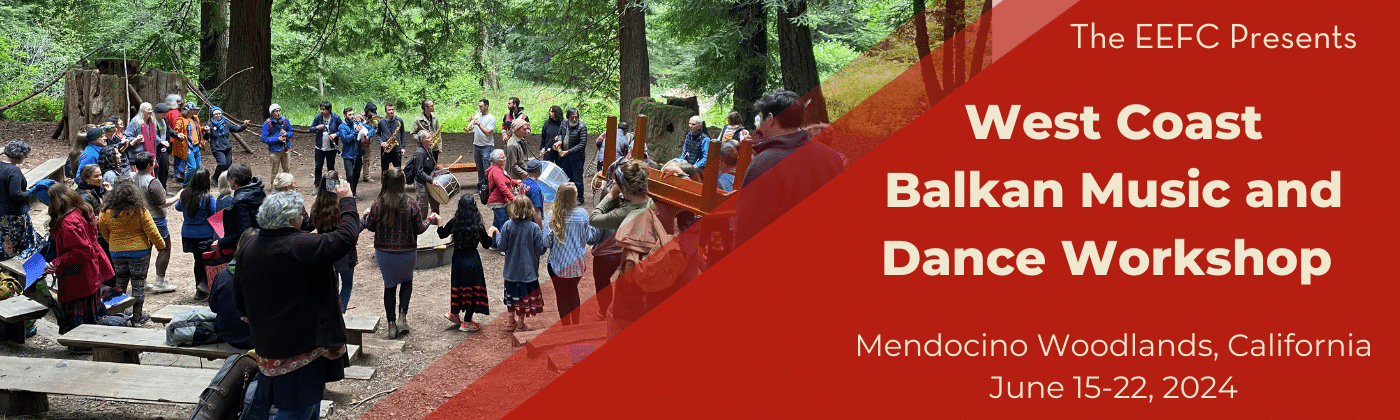
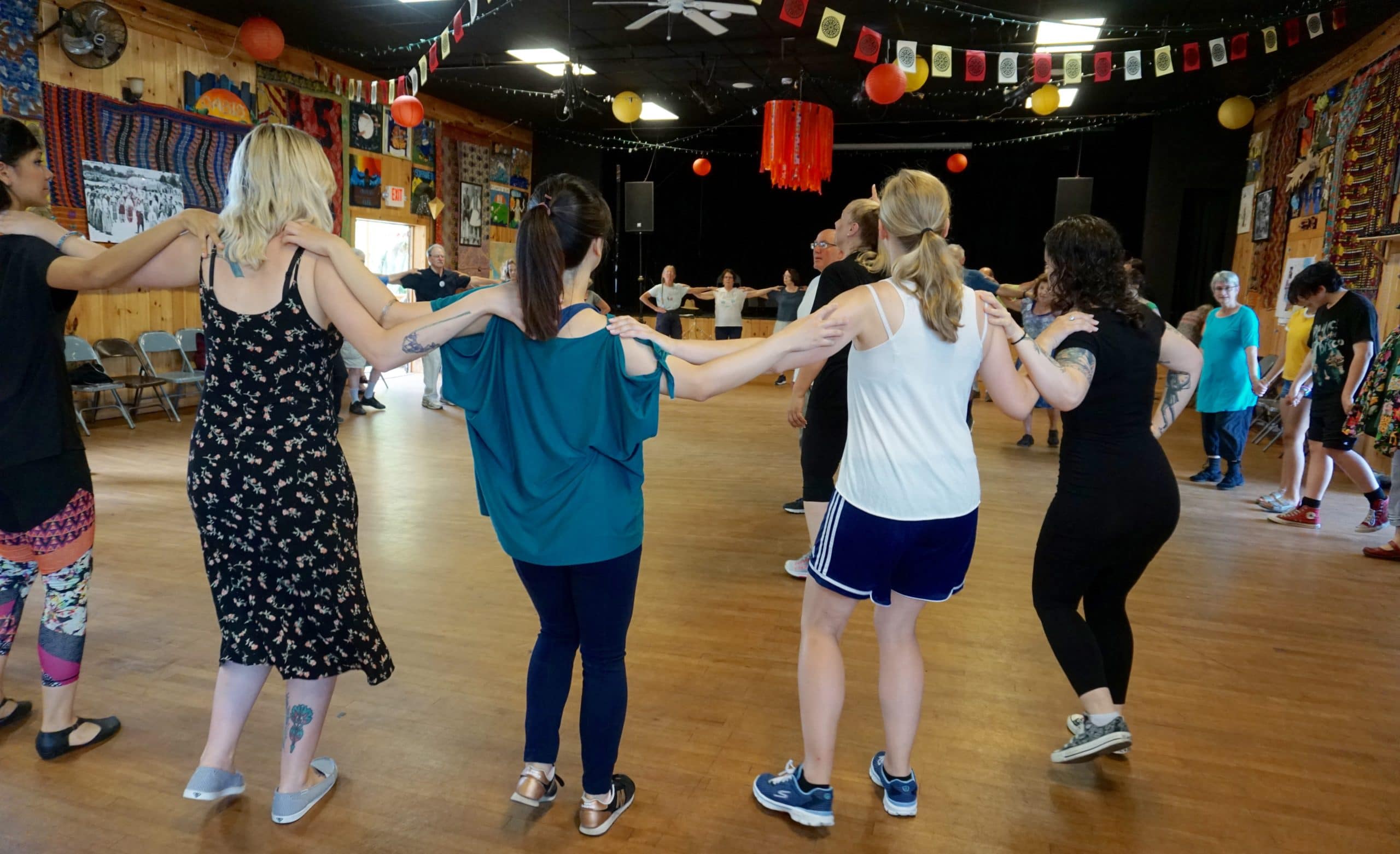
The Mendocino Balkan Music & Dance Workshop is located in the Mendocino Woodlands, in the redwood forest inland from the northern California town of Mendocino.

Dance Singing Instruments KidsWaiting ListWork Exchanges

***Please note the staff and schedule are subject to change***

It is possible to attend the evening parties, which begin at 9 p.m. if you register before June 24.  The cost is $20 per person per evening.  Admission includes evening dance parties and late-night kafana activities until 2:30 a.m. (no overnight accommodations). 

Waiting list: Please note that the Mendocino Workshop fills up almost immediately.  Once we determine that the workshop is full (in recent years this happens by mid-April), late registrations will automatically be placed on the waiting list.  You will be notified of your status as soon as possible.  If you are put on the waiting list, your check will not be deposited until your status changes.  To get the registration materials (brochure) early, be sure to become an EEFC member

The 2004 workshop is currently full, however you have until June 24 to register to attend the evening parties.

Work Exchanges: A few partial-tuition waiver work exchanges may be available for full-week participants.  Contact the EEFC office for more information.  Each year the EEFC also offers a full tuition scholarship called the Kef Scholarship.

♦♦♦♦♦♦♦♦♦♦♦♦♦♦♦♦♦♦♦♦♦♦♦♦♦♦♦♦♦♦♦♦♦♦♦♦♦♦♦♦♦♦♦♦♦♦♦♦♦♦♦♦♦♦♦♦♦♦♦♦♦♦♦♦♦♦♦♦♦♦♦♦♦♦♦♦♦♦♦♦♦♦♦


2004 MENDOCINO STAFF 

2004 INSTRUMENTS & ENSEMBLES

Dan Auvil (beg. & int. tupan)
If you’d like to experience the joys and job opportunities available from playing a dual-cephalic membranophone, this class is for you. No prerequisites necessary for beginning students. Career guidance and attitude assistance may be available for intermediate class. Dan currently plays with the bands Ziyiá, Édessa, Zabava! Izvorno and occasionally with Balkan Cabaret and Orkestar Sali. His 30-year involvement with the tupan includes numerous recordings and has taken him to Bulgaria, Greece, Japan and now Mendocino.

David Bilides' (beg. Macedonian tambura & Macedonian village ensemble) first encounters with Balkan folk music were the weddings, picnics and dances of the Asia Minor community in which he grew up. In 1974 he helped form the Boston group Evo Nas, one of the first Balkan village music ensembles in the eastern U.S. He was fortunate to have performed several times with Pece Atanasovski. He now resides in Seattle, where he plays Greek music with Pangéo, and accompanies Dragi Spasovski on kaval and tambura. He also plays Macedonian music with Slavej and other musicians at various folk music and dance events around the country.

Lefteris Bournias (int. & adv. clarinet—Tues.-Fri. only) has been playing clarinet since the age of 11, and has performed extensively in the U.S. and abroad. As a young man living in Athens, he took lessons from his neighbor, the famous Rom clarinetist Vasilis Soukas, and attended the Athens Conservatory. Lefteris holds a degree in Music Education, is studying towards a Ph.D. in ethnomusicology, and teaches extensively in the New York City area. Accomplished in diverse styles, he is well acquainted with traditional Greek folk, Rom and a la Turka genres, and has performed and recorded with many acclaimed singers and musicians. Among many other groups, he performs with Kavala Brass Band and Orkestra Keyif in the NYC area.

Paul Brown (house bassist—non-teaching) has been playing music for 29 years, studying bass and composition at the Berklee College of Music in Boston, and oud with Haig Manoukian and Necati Çelik. He was adjunct music faculty in the Contemporary Music Department at the College of Santa Fe from 2000 to 2003 and has been house bassist for the Balkan Music & Dance Workshops since 1995. During a recent stay in New York City he studied and played with Souren Baronian’s Taksim and the Aegean Macedonian group Kavala. He also performs with Orkestra Keyif and Édessa, among others. Explorations into the realm of the bass have drawn him of late into the tuba.

George Chittenden (beg./int. zurna; int. & adv. clarinet—latter Sun.-Mon. only) has been playing Balkan and Turkish music since the mid-70s. He has studied music extensively abroad, focusing primarily on regional dance music of northern Greece and Anatolian Turkey, including research into playing techniques on wind instruments such as the zurna, gaida, and clarinet, as well as the cultural context for music and dance. George performs regularly for ethnic communities and folk events throughout the country and abroad. He currently plays with Ziyiá, a traditional Greek music ensemble, and Édessa, a Bay Area band known for playing high-energy dance music from the Southern Balkans.

Beth Bahia Cohen (int. & adv. Greek & Turkish violin) plays the violin, various lyras from Greece and the Turkish yaylı (bowed) tanbur, performing Greek music with Ziyiá, Demetri Tashie, Panayotis (Paddy) League, Lefteris Bournias and others. She has studied and played with eminent composers and instrumentalists in Greece, Turkey and Hungary. She has performed with Libana, The Klezmer Conservatory Band, EurAsia Ensemble, Sárkány, Sophia Bilides, Karaváni, and Taxími, and most recently with Orkestra Keyif. Beth is performing her own and traditional music on various bowed instruments in solo “Art of the Bow” performances. She has just produced her first solo CD, entitled “Weaving the Worlds.”

Polly Tapia Ferber (int. doumbek & int./adv. frame drum) is a music educator, performer and recording artist who specializes in hand percussion from the Middle East, Turkey, North Africa, the Balkans and Spanish Andalucía. She has traveled to Egypt, Greece, Spain, Morocco and Israel, seeking out the finest teachers and performing with some of the world’s most renowned musicians. Polly currently plays with several New York City-based bands including Orkestra Keyif, Merak and Transition. She is on the faculty at the College of Santa Fe in the Contemporary Music Program where she teaches percussion, develops classes in world music and women in music, and directs the MidEast/Balkan ensemble there.

Valeri Georgiev (beg. & int. Bulgarian kaval) is from the Bulgarian Danube town of Ruse. He studied kaval in Kotel and graduated from the Plovdiv Conservatory with a degree in folk-ensemble conducting. He performed in the Plovdiv-based ensemble Puldin, then later directed the folk-theatrical group Najden Kirov and performed with Orkestur “Horo” in Ruse. Valeri was the composer for the theater piece “Geracite” and has arranged many folk songs and instumental melodies. He has accompanied many famous singers, including Kalinka Vulcheva, Yanka Rupkina, Vesela and Lyuben Bojkovi and Kremena Stancheva. He resides in the DC area where he plays with Lyuti Chushki.

Michael Ginsburg (brass band) has been director and lead trumpet player of Zlatne Uste Balkan Brass Band since 1983. He accompanied Zlatne Uste to brass band festivals in Guca, Serbia, three times between 1987 and 1990 and again in 2003. During those visits Michael and his band took advantage of many opportunities to play and party with local brass bands and to experience the music in its natural setting. He has worked with some of the leading musicians of Macedonia, including Kurtis Jasarev Kadriev, Zahir Ramadanov, Stevo Teodosievski, and members of Kocani Orkestar. In August of 2003 Michael and Zlatne Uste worked closely with Ekrem Sajdic and Zlatni Prsti brass band in Vranjska Banja, Serbia.

Christos Govetas (Greek ens.) see Singing

Kalin Kirilov (int./adv. accordion & Bulgarian melody & ornamentation), born in Vidin, NW Bulgaria, began singing and playing the accordion at the age of four and received his first gold medal as a singer in 1981 at the Koprivshtitsa Festival. He studied music in Vidin and Pleven and graduated from the Academy of Music and Dance in Plovdiv in 1998 with a specialization in tambura and music pedagogy. He received a Master’s Degree in folklore last year from the University of Oregon, where he is now a Ph.D. student in music theory. Kalin has performed extensively in Bulgaria and abroad, recorded with Bulgarian National Radio, and toured the U.S. this past fall with the legendary Ivo Papasov and Yuri Yunakov.

Nikolay Kolev (beg. & int. gudulka), a native of Karavelovo in Bulgarian Thrace, has been playing gudulka since age 10. After graduating from the music school in Shiroka Luka, he has perfomed constantly, first as soloist of the Sliven folk ensemble and later as orchestra director of the Sopot folk ensemble. In 1985 Nikolay formed the folk wedding music ensemble Rozova Dolina, and in 1992 founded the prize-winning ensemble Balkanski Glasove. Nikolay and Donka Koleva produced a CD featuring recordings of current and former students of the Shiroka Luka music school, entitled “Shiroka Laka Singing.” The Kolev family performs in the New York City area.

Haig Manoukian (int. oud & makam) was introduced to his instrument and to many great musicians through the Turkish 78 rpm records treasured by his Turkish-Armenian family. He took up the oud during his college years and soon found himself living in New York in the middle of 8th Ave., then the center of a thriving Middle Eastern music and dance scene. Over the years he has played with many great Turkish, Greek, Armenian and Arabic musicians. Haig has performed at many prestigious venues in the U.S. and Europe with his longtime musical partner, clarinetist Souren Baronian. He repairs and reconditions ouds at his studio in New York and teaches oud and Eastern music theory at specialized music camps and workshops.

Tobias Roberson (beg. & adv. doumbek) began his percussion training at age 14 with the UC Santa Barbara Middle Eastern Ensemble and has studied in Cairo and Istanbul. Now living in the Bay Area, Tobias works with many belly dance troupes and performs Balkan music with Hector Bezanis, The Toids and Stellamara.

Rumen “Sali” Shopov (int. Bulgarian tambura) is a native of Gotse Delchev, in SW Bulgaria. Master of the tambura, bouzouki, various drums as well as an accomplished singer, he was concertmaster of the Nevrokop Folk Ensemble, Bulgaria’s first national folk ensemble, for more than 20 years. He was also a lead member of two of Pirin region’s hottest bands, Shturo Make and Orkestur Orbita. In 2002, Rumen toured the U.S. with the Kolevera Folk Ensemble. Now residing in the Bay Area, he is leader of Orkestar Sali, a band that captures and showcases the soul of Rumen’s native Turkish-Romani/Bulgarian musical tradition.

Ivan Varimezov (int. Thracian gajda & Bulgarian village ens.) was born in Sredets, in eastern Bulgaria. He began his musical education at the knee of his uncle, the renowned gajda player Kostadin Varimezov. Ivan graduated from the Plovdiv Conservatory with a major in instrumental performance and conducting. He performed with the Trakiya Ensemble in Plovdiv and was soloist with the Pazardzhik Ensemble as well as the prestigious Philip Koutev and Bulgarian National Radio ensembles. In 1993 he co-founded the group Balkanfolk and produced a CD with them. Since 2001 he has taught gajda and conducted the Balkan folk orchestra at UCLA.


2004 SINGING

Christos Govetas (int. Greek) is from the village of Próti in the province of Sérres in Greek Macedonia, and is an accomplished singer and bouzouki, laouto, oud, clarinet and zourna player. While in Boston he played with Taxími, The Eur-Asia Ensemble, Karaváni, Tito’s Revenge and Akshambelah. He is a member of the traditional Greek band Ziyiá, and in Seattle performs Greek and Balkan music with Pangéo, Greek music from Asia Minor with Sultána, and is side-man for Cerise. He appears with Bill Frisell on the Grammy-nominated CD “The Intercontinentals,” and was the 1999 recipient of the Northwest Arts Council Fellowship Award for his contribution to the Greek-American and U.S. folk dance communities. (See also Instruments)


Ruth Hunter (beg. Balkan) has been singing and playing music of the Balkans since the early 80s. She has taught voice and tambura at many music and dance events and performed in concerts throughout the U.S., Canada and Europe. A veteran of such San Francisco Bay Area groups as Medna Usta, The Balkan Noyz Boyz, Bay Area Balkan Ensemble and The Balkan Appliances, she also played in the Boston area with Karaváni, Akshambelah, and Tito’s Revenge. She now lives in Seattle and plays Greek and Balkan music with Pangéo, Greek music from Asia Minor with Sultána, and European café music and Balkan songs with Cerise.


Brenna MacCrimmon (int. & adv. Turkish) started to learn and perform Balkan and Turkish music with community groups in Toronto. Over the years, she has made several extended trips to Turkey to study the traditions there. In 1998 she produced and was the featured vocalist on the CD “Karsilama,” a bevy of Thracian and Rumeli songs performed with Turkish clarinetist Selim Sesler. She also performs with Ayde Mori, a Turkish Balkan band, and Baba Zula, a Turkish free-form folk psychedelic outfit. In North America, Brenna performs old city music of Istanbul with Orkestra Keyif, and occasionally she manages to squeak in a song or two with Édessa. Brenna will be teaching Turkish Rumeli and Istanbul city songs


Carol Silverman (int./adv. Romani) is a professor of folklore and cultural anthropology at the University of Oregon and has also taught Balkan singing for over two decades. Since the 1970s she has done extensive field research on Bulgarian music and politics, and since 1980 has worked with Roma in Macedonia, Bulgaria and New York on human rights and culture. As a vocalist with the Yuri Yunakov Ensemble since 1995, she has performed in festivals in the U.S., Canada and Australia. In 1999 she toured with the Ensemble as part of “The Gypsy Caravan,” also serving as its educational coordinator, and in 2003 she toured with Ivo Papasov. She also sings with Trio Slavej.

Michele Simon (Balkan vocal technique) has been performing Balkan music for 15 years, and dancing to it for over 30. She has studied singing with Mary Sherhart, the late Nadezhda Hvojneva and Tatiana Sarbinska, the latter with whom she also trained as a teacher. Michele sang with Kitka for 9 years, and is currently a vocalist with Orkestar Sali, Anoush and Brass Menagerie, in which she also plays tapan. Michele’s fascination with the challenge of Balkan singing for American voices has drawn her into 10 years of teaching. Her class is for singers of all levels. It is a place to ask questions, experiment with placement, pronunciation, ornaments and whatever else you’d like to explore. Not for the squeamish—phlegm will be discussed.

Dragi Spasovski (beg. & adv. Macedonian) learned to sing from his mother, whose sweet voice was the backdrop to his boyhood in Skopje. Her repertoire seemed limitless and her love of singing infused his life. Beginning in 1969 he recorded around 150 traditional, city and calgija songs with Radio Skopje. Dragi was a member of the Orce Nikolov Folk Dance Ensemble for many years, and in the early 70s he lived in Seattle and was a member of Koleda Folk Ensemble. Two years ago he returned to Seattle, where he is a guest vocalist with Balkan Cabaret. He is active in a variety of musical venues, including Songs & Stories, New Land Choir and Cyril and Methodius Day.

Tzvetanka Varimezova (beg. & int. Bulgarian) was born in Pazardzhik in Bulgarian Thrace, and started singing and playing accordion at age 9. She went on to master tambura and piano, and studied folk music at Kotel High School for Folk Music and at the Plovdiv Conservatory. She performed with Ensemble Trakiya for five years and conducted the Pazardzhik Ensemble choir for seven. In 1993 she began working with two Bulgarian-style choirs in Denmark, and also sang with Cosmic Voices from Bulgaria and with Les Grandes Voix Bulgares. She performs regularly with her husband Ivan Varimezov. Since 2001 they have been in residency at UCLA, where Tzvetanka directs the women’s Bulgarian choir.


2004 DANCE

Michael Ginsburg  (Balkan, one class per day)
has taught widely at camps and workshops around North America, as well as in Germany, Brazil, Israel and Japan. He has been teaching folk dance for over 30 years. Michael’s repertoire includes dances from Romania, Bulgaria, Serbia, Croatia, Macedonia and Greece—material he learned from ethnic communities as well as dances learned from other master teachers. Michael’s teaching is clear and concise, and his classes have something for everyone, from novice to expert dancer.

Joe Kaloyanides Graziosi  (Greek, two classes per day)
has done extensive field research on regional dance in Greece and among Greek communities in the U.S. He has taught throughout the world for community groups and at major folk dance camps. Joe was director of the Greek Music Tour sponsored by the NEA and the Ethnic Folk Arts Center in 1982. He has served as judge and advisor for the West Coast Greek Orthodox Folk Dance Festival since 1984, and is co-founder and co-director of the annual World Music & Dance Camp at Cape Cod.

Ahmet Lüleci (Turkish, two classes per day)
A native of Turkey, Ahmet taught several excellent ensembles there. His fascination with dance led him to research the historical, social and cultural background of costumes and spoon dances of Turkey’s Mediterranean coast. His published study earned him a prestigious award by the Turkish government in 1985. Since coming to the U.S., he has taught at the major camps throughout the U.S. as well as in Asia, Europe, Australia and South America. He is currently the artistic director of Collage Dance Ensemble of Boston. Ahmet is co-founder and director of World Camp. In 2002 he was presented with the Award for Outstanding Achievement in the Arts & Humanities by the Assembly of Turkish American Associations.

KIDS

We welcome families!

Frank Garcia (dance) has taught dance to elementary and high school students since 1994 and implemented dance programs at both McKinleyville High School and Sunset Elementary School of the Arts in Humboldt County. Frank danced with the Humboldt Folk Dancers, Ballet Folklórico de Humboldt and the New World Youth Ballet. In addition to folk dance, Frank practices other dance forms, including break dancing, hip hop, modern, ballet, salsa and swing. He was an active member of the California Dance Educators Association for six years and also teaches Spanish and coaches sports in high school.

The dance class is designed for children 6 to 14 years old.  Children are also welcome and encouraged to take adult classes according to their capabilities. 

Greg Jenkins (kids’ band) is a young, strapping clarinetist and tenor sax player who has been involved in the Balkan folk dance community since he was born. He has attended the Mendocino camp nearly every year since 1995. His interests include Balkan brass band music and Greek clarinet. Greg has played numerous gigs in the San Francisco Bay Area. He has informally led the Mendocino Kids’ Band for three years. It will be loud, raucous and solo-oriented, and will culminate in a live performance for dancers.


Kids’ Band is designed for young people ages 1-21 and gives them a showcase where they can shine all on their own.

Please note that children must be housed with their parents or guardians.  Parents should be aware of the adult nature of the Workshop (alcoholic beverages and occasional skinny-dipping).

♦♦♦♦♦♦♦♦♦♦♦♦♦♦♦♦♦♦♦♦♦♦♦♦♦♦♦♦♦♦♦♦♦♦♦♦♦♦♦♦♦♦♦♦♦♦♦♦♦♦♦♦♦♦♦♦♦♦♦♦♦♦♦♦♦♦♦♦♦♦♦♦♦♦♦♦♦♦♦♦♦♦♦♦♦♦♦♦♦♦♦♦♦♦♦♦♦♦

EVENING PARTY SCHEDULE 

Please note the schedule is subject to change & don't forget to register before June 24!

Evening parties begin at 9 p.m. unless otherwise noted.  The cost is $20 per person per evening.  Admission includes evening dance parties and late-night kafana activities until 2:30 a.m. (no overnight accommodations).  Pre-registered partygoers may check in and pay at the kafana upon arrival at the camp.  Please plan to arrive after 8 p.m. and note that we cannot accept drop-in party goers.

Saturday Sunday Monday Tuesday Wednesday Thursday Friday
(party starts at 9:45)

1. Bitov (village-style Bulgarian)
2. Greek, etc.     
   Pangéo

1. Rhodope sing-a-long (Bulgarian)
2. S. Balkan
   
Édessa
1. Macedonian
2. Romani
   Trio Slavej
1. Bulgarian
2. Greek Island and more
(party starts at 10)

1. Brass & Aegean Macedonian
2. Izvorno (village-style Macedonian)

1. Turkish
    Orkestra Keyif
2. Zurnas
3. Bulgarian

(party starts at 8)

1. Student Ensembles
2. Greek
   
Ziyiá


♦♦♦♦♦♦♦♦♦♦♦♦♦♦♦♦♦♦♦♦♦♦♦♦♦♦♦♦♦♦♦♦♦♦♦♦♦♦♦♦♦♦♦♦♦♦♦♦♦♦♦♦♦♦♦♦♦♦♦♦♦♦♦♦♦♦♦♦♦♦♦♦♦♦♦♦♦♦♦♦♦♦♦♦♦♦♦♦♦♦♦♦♦♦♦♦♦♦♦♦

Return to the EEFC home page